Why Repair Pricing Is So Hard to Find in Miami
Search for blind or shade repair in Miami and you will find plenty of companies willing to sell you new window treatments. What you will not find is a straight answer about what a repair involves or what drives the cost of one. Most repair work in this city is quoted over the phone, sight unseen, by someone who has not looked at the product yet.
That is not obstruction so much as physics. A roller shade that will not go all the way up and a roller shade that has fallen out of its brackets look like the same complaint in a text message and are two completely different jobs. One is an adjustment. The other may need new hardware and a re-mount into something that will actually hold.
This guide does the next best thing to a price list. It explains exactly what a technician is assessing when they work out what your repair takes, so that when you do get a quote you understand what you are being quoted on and can tell a fair assessment from a brush-off.
Here is the one fixed number: service calls start from $150. What happens after that depends on the questions below, and the table at the end of this article sums up what drives the cost and how to get a faster quote.
The First Question: What Is Actually Broken
Repairs fall into a few recognisable families, and which family yours belongs to matters more than the brand on the headrail or the size of the window.
Adjustments. The mechanism works but is out of calibration. A shade stops six inches short of the sill, or runs past the bottom and keeps going. On motorised units these are travel limits and they are set in software. On manual units it is usually the chain, the clutch, or the tension. Nothing has failed here; something has drifted.
Cord and string failure. Most common on Roman shades. The lift cords run through rings on the back of the fabric, and when one snaps or frays the shade stops lifting evenly. You will usually notice it as one side rising faster than the other before it fails outright. This is restringing work, and a shade that has gone visibly crooked is often restrung rather than repaired piecemeal, because a single replacement cord in an otherwise aged set tends to be followed by the next one snapping a few months later.
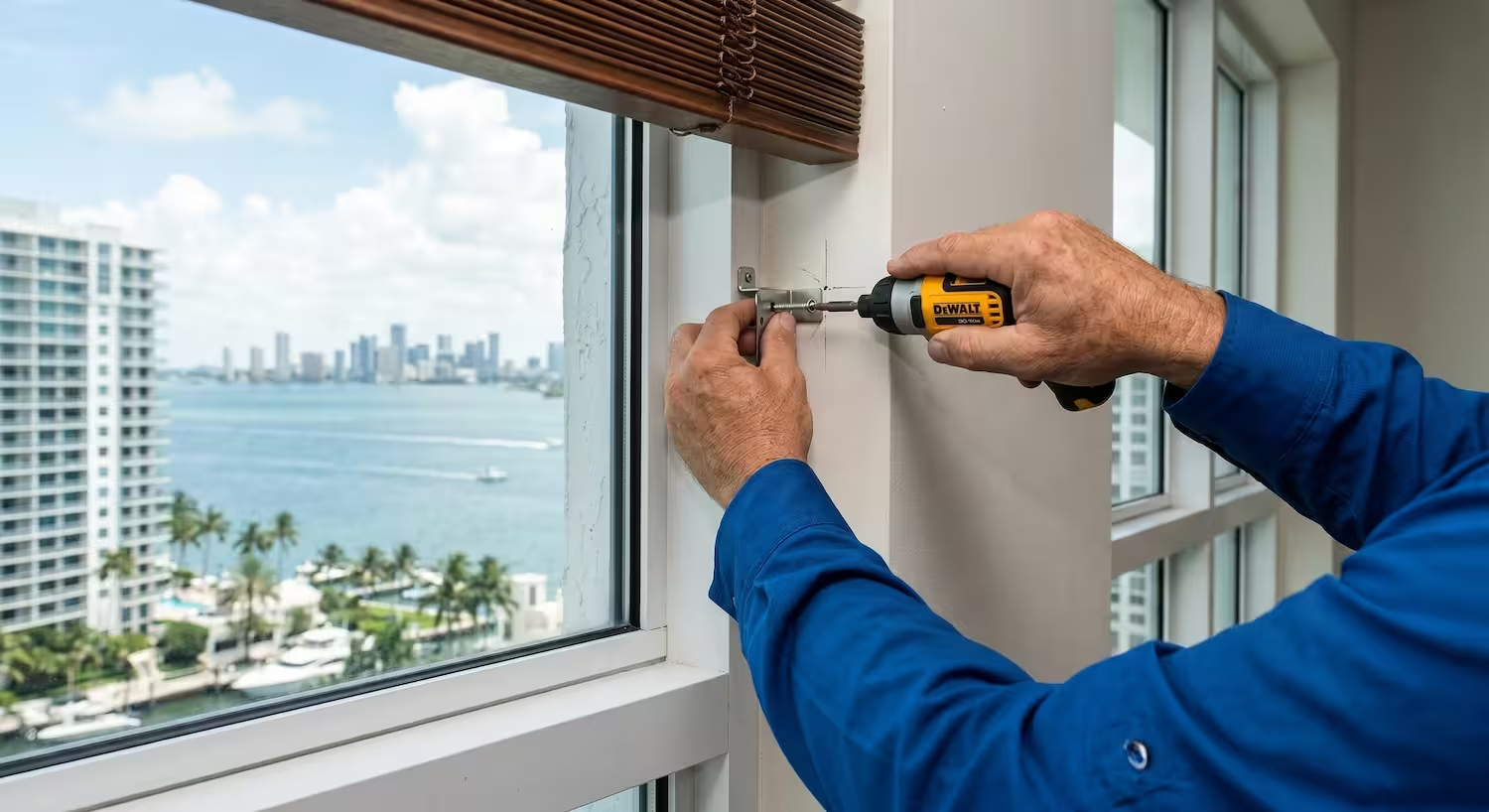
Mounting failure. The shade came down. Sometimes the brackets pulled out of the wall, sometimes the anchors were never right for the substrate. Miami adds a specific wrinkle here that we will come back to.
Motor and electronics. The blind is unresponsive, or the remote no longer talks to it. This ranges from re-pairing a remote to setting new limits to replacing the motor entirely, and those are very different amounts of work. Our motorised shade repair page covers the specifics.
Sizing. Not a failure at all. Some blinds and shades can be cut down to fit a narrower window, which is worth knowing before you buy a replacement for something that is simply too wide.
The Second Question: Can the Part Be Sourced
This is the single biggest swing factor in any window treatment repair, and it is the one homeowners rarely anticipate.
A motor is not a generic component. Somfy, Lutron and Rollease Acmeda all build to their own specifications, and a replacement has to match the tube diameter, the mounting, the control protocol and the power source. Sourcing a like-for-like motor for a ten-year-old system is a different exercise from swapping one on a current model.
The same logic applies to clutches, brackets, cord locks, tilt mechanisms and shutter hinges. Where a part is current and stocked, the repair is straightforward. Where a line has been discontinued, a technician is either finding a compatible substitute or engineering around the gap — and that is real work that a quote has to account for.
This is also why the honest answer to "what does this cost" often genuinely is "let me see it first." Not evasion. The part determines the job.
What About Unbranded Units?
A great many blinds and shades in Miami condos have no brand on them at all — builder-grade units installed at handover, or product bought from a store that has since closed. Owners of these are routinely told nothing can be done because the manufacturer cannot be identified.
That is usually not true. Mechanisms across the industry are more standardised than the branding suggests, and a chain, a clutch or a set of brackets can very often be matched by specification rather than by name. Miami Shades repairs all brands including no-name units, which in practice is the difference between a service call and buying a whole new window treatment.
The Third Question: Access
Where the window is affects the work. A shade over a stairwell, a twelve-foot span in a double-height living room, or a run of windows behind fixed furniture all take longer than a standard bedroom window, and a quote reflects that.
High-rise access carries its own overhead in Miami specifically. Buildings in Brickell, Aventura and Sunny Isles frequently require certificates of insurance filed in advance, service elevator reservations, and loading dock windows that are only open certain hours. None of that is difficult, but it is time, and it is time that a technician working in a single-family home in Coral Gables does not spend.
The Miami Factor: Why Things Fail Here Faster
South Florida is genuinely harder on window treatments than most of the country, and understanding why helps you judge whether a repair is a one-off or a symptom.
Salt air is corrosive to metal components, and coastal buildings see it constantly. Humidity swells and warps natural wood, which is why composite has largely displaced real wood in Miami shutter installations. Sustained direct sun degrades fabric, cord and plastic — a west-facing wall of glass in Miami accumulates UV exposure that a comparable window in a northern climate simply does not see.
Then there is cycling. Motorised shades on a daily schedule in a Miami condo run their motors twice a day, every day, for years. Nothing about that is abnormal, but it means motors here reach their duty limits sooner than a manufacturer's average would suggest.
Practically, this means a Miami repair estimate is worth asking two questions about: what failed, and whether the conditions that caused it are going to cause it again. A shade that fell because the anchors were wrong for the substrate will fall again if it goes back up on the same anchors.
What a Straight Quote Should Include
Whoever you call, a quote worth acting on tells you four things.
- What is wrong, in plain terms, not just "it needs servicing"
- What the fix involves — adjustment, part replacement, re-mount, or full unit replacement
- Whether parts need sourcing, because that governs the timeline as much as the cost
- Whether the same failure is likely to recur, and what prevents it
If a quote arrives without an inspection and without any of the above, treat it as a rough indication rather than a commitment.
How Miami Shades Handles Repair Assessment
Artur Melnyk, who runs the repair side of Miami Shades, works the assessment in the same order every time: identify the failure, establish whether the part is sourceable, then check whether the installation conditions caused it.
The fastest route to a real answer is a photograph. A clear phone photo of the window treatment, plus one of the headrail or mechanism if you can reach it, is usually enough to identify the failure family and whether a part is likely to be available. That short-circuits most of the guesswork before anyone drives anywhere.
On timing: Often same day, always within 1–2 days. Repair service covers the same South Florida radius as installation work, and both residential and commercial jobs are taken — see commercial window treatment service for buildings and property managers.
The full range of what can be repaired is on the window treatment repair page, with dedicated detail for blind repair, shade repair and cut-down sizing.
Getting an Answer on Your Own Window Treatment
If something in your home or building has stopped working properly, the useful next step is not a price list — it is a look at the actual unit. Send a photo and get a free quote, or call (786) 373-7374 and describe what it is doing. Either way you will get a straight assessment of what is wrong and what it takes to fix.
Frequently Asked Questions
Why won't companies quote blind repair over the phone?
Because the same described symptom can have several different causes, and the fix depends on which one it is. A shade that will not raise fully might need a limit adjustment, a new clutch, or restringing. A photo narrows it down enormously, which is why most repair services ask for one before quoting.
Can you repair blinds and shades you didn't originally sell?
Yes. Miami Shades repairs all brands, including unbranded and builder-grade units with no manufacturer marking. Mechanisms are more standardised than the branding suggests, so parts can usually be matched by specification even when the original maker cannot be identified.
Is it worth repairing an older window treatment or should I replace it?
It depends mostly on whether the part is available and whether the rest of the unit is sound. A single failed mechanism on an otherwise good shade is usually worth repairing; widespread fabric degradation or a discontinued system with several failing components often is not. Our guide on repair versus replacement walks through how to judge it.
How quickly can someone come out for a repair in Miami?
Often same day, always within 1–2 days. Repair calls are prioritised differently from installation consultations because a broken shade in a Miami bedroom is an urgent problem in a way that choosing new drapery is not.
My blind is too wide for the window. Do I have to buy a new one?
Often not. Many blinds and shades can be cut down to a narrower width, though it depends on the type and construction. Send a photo of the unit and the window and it can usually be confirmed quickly whether yours is a candidate.