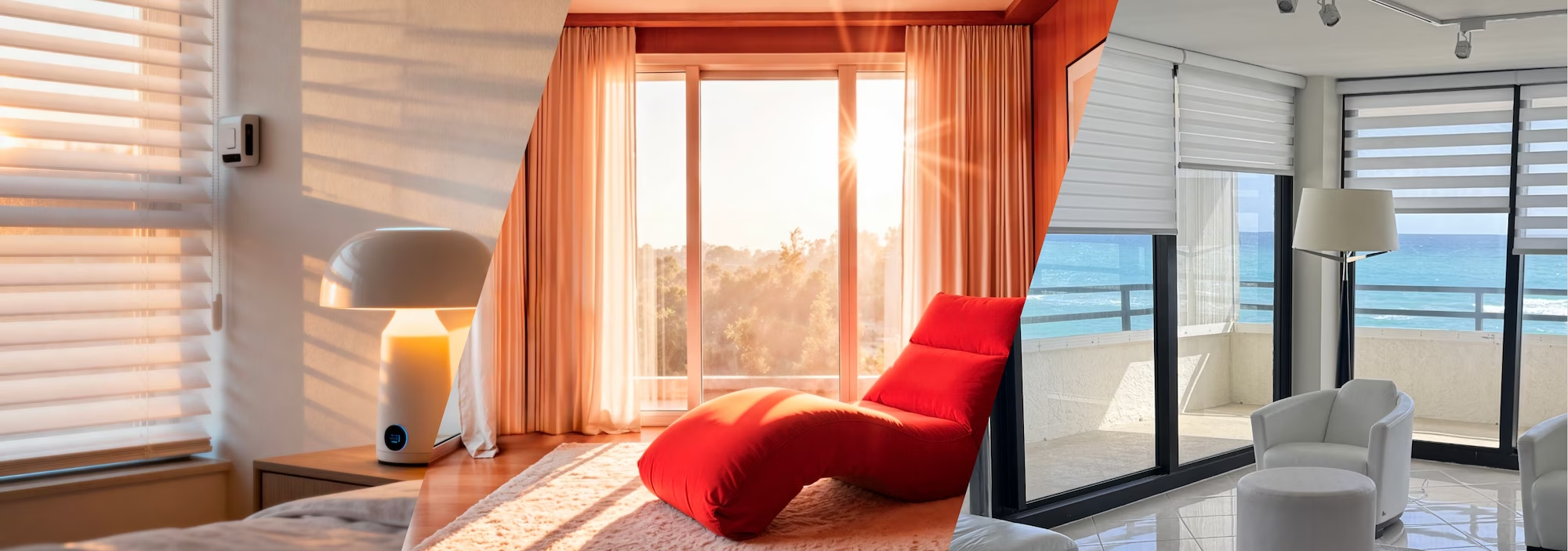
Motorized shades have crossed over from luxury upgrade to practical utility in South Florida. The combination of intense afternoon sun, sky-high AC bills, expansive glass in modern Miami construction, and the rise of whole-home smart systems has made automated shading one of the highest-ROI window treatment decisions a homeowner can make. This guide walks through what motorized shades actually do, the brands worth installing, how they pay for themselves, and how to integrate them with the smart home you already have.
What motorized shades are — and what they aren't
A motorized shade replaces the manual chain or wand with a small, quiet motor inside the headrail. You operate it with a wall switch, a handheld remote, an app, a voice command, or a schedule. That's the surface answer. The deeper answer is that a motor changes which window treatments make sense in which rooms.
Tall windows that would be tedious to lift manually become trivial. Hard-to-reach skylights, transom windows, and clerestory glass become functional rather than decorative. Banks of three or four windows that always ended up at four different heights now move in perfect unison. And shades that you used to forget to lower close themselves at the right moment, every day, automatically.
What motorized shades aren't: a gimmick. The motors from Hunter Douglas, Lutron, Somfy, and Rollease Acmeda are built to commercial spec. Expected lifespan is 15–20 years of daily use — longer than most homeowners keep the same window treatments anyway.
How motorized shades reduce AC costs in Miami
Florida Power & Light data shows that the average Miami-Dade home spends 40–55% of its electric bill on cooling. Solar heat gain through unshaded west and south-facing windows is one of the biggest contributors. A correctly programmed motorized shade addresses this directly.
The math: a single 6-foot-by-8-foot west-facing window in Miami can transmit 8,000–12,000 BTU/hour of heat at peak sun — roughly equivalent to a 1-ton AC unit running just to fight that one window. A 3% openness solar shade blocks 80–90% of that heat. A blackout shade closed during peak sun blocks essentially all of it.
The trick is timing. A manual shade only helps if you remember to close it. A motorized shade on a schedule closes the moment direct sun hits the window and reopens once the sun has moved past — protecting the view for the rest of the day. Owners who automate west-facing shades typically see a measurable drop in summer cooling load. The shades essentially front-load the sun's energy back outside before your AC ever sees it.
Beyond the bill, the comfort difference is immediate: rooms stop having a hot corner. Hardwood floors don't bake. Leather sofas don't fade. Art doesn't yellow.
Smart home integration: Alexa, Google Home, Apple HomeKit
Motorized shades have become genuinely useful smart home devices over the last few years. The integration story varies by brand:
Hunter Douglas PowerView
The PowerView app is the control center. From the phone you create scenes ("Morning," "Sunset," "Movie"), schedules tied to local sunrise/sunset, and rooms that group multiple shades. PowerView integrates natively with Alexa, Google Home, Apple HomeKit, Control4, Crestron, Savant, and SmartThings. Voice commands like "Alexa, close the living room shades" work out of the box.
Lutron Sivoia QS / Serena
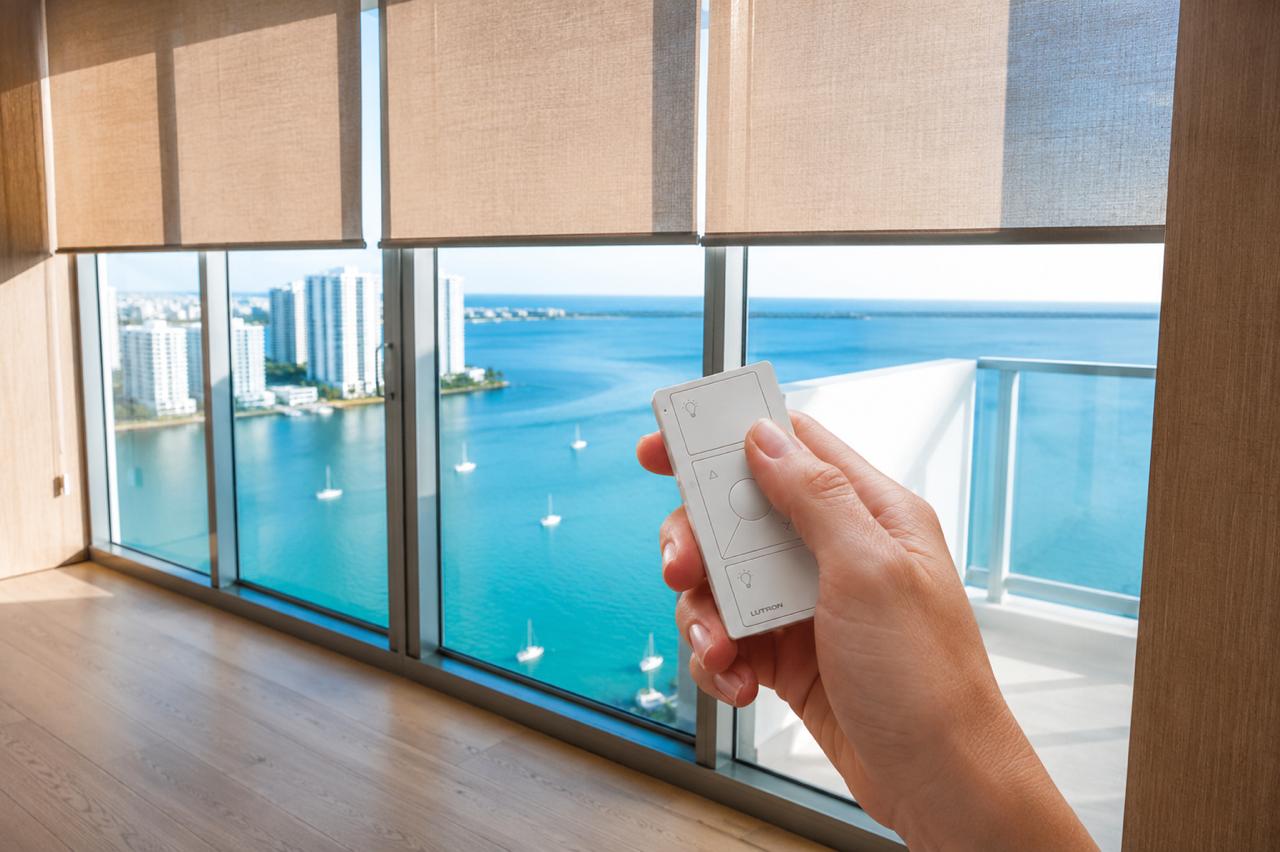
Lutron's reputation for reliability is the reason it shows up in nearly every high-end Miami home and condo. The Caseta and RA2 Select hubs tie shades into the same system as your Lutron lighting. Apple HomeKit integration is excellent. Lutron is also the standard for builders and architects — if your home was wired for Lutron during construction, your shades should be Lutron.
Somfy
Somfy makes motors, not shades — their motors are inside many third-party shade brands. The TaHoma hub connects Somfy motors to Alexa, Google Home, and IFTTT. Best for owners who want a wider fabric selection and don't need the seamless brand-app experience of Hunter Douglas or Lutron.
Rollease Acmeda Automate
The dark horse. Pulse 2 hub, native Alexa and Google Home integration, and motors built into a wide range of fabric brands. Often the right pick for projects where the priority is fabric selection and the smart-home requirement is mainstream rather than enterprise.
Schedules that make sense for Miami
The single biggest unlock with motorized shades is automation — not having to think about them. The schedules we set up most often for South Florida homes:
- Sunrise open, gradual: Bedroom shades open slowly starting 30 minutes before sunrise so the room lightens naturally rather than jumping awake at full brightness.
- Solar noon close (west-facing): West-facing living room and primary bedroom shades close at solar noon and reopen once the sun has cleared the room — typically 4 hours, depending on season.
- Sunset privacy: All ground-floor and view-side shades close 15 minutes after sunset to prevent the lit-aquarium effect.
- Vacation random: While you're away, shades open and close on randomized schedules within a programmed window so the home looks lived in.
- Storm preparation: One button or voice command closes every shade in the house before a storm hits — protects fabric, reduces glass impact risk, and keeps debris from finding its way into the room if a window breaks.
Quiet operation: what to listen for
Motor noise used to be the deal-breaker complaint about motorized shades. The current generation has solved it. Lutron Sivoia QS is rated at under 30 dB — quieter than a refrigerator. Hunter Douglas PowerView Gen 3 motors are similarly quiet. Somfy Glydea, used in motorized drapery tracks, is whisper-grade.
If you're considering motorized shades for a primary bedroom or media room where sound matters, ask the installer to demo the motor in your space before fabrication. The acoustic environment of a Miami condo with hard floors and floor-to-ceiling glass amplifies any motor noise; the acoustic environment of a carpeted Coral Gables bedroom dampens it. Both contexts matter for the brand and motor pick.
Power: hardwired, plug-in, or rechargeable battery
Three power options, three different installs:
- Hardwired: The motor pulls power directly from a low-voltage line run during construction or a retrofit. No batteries to swap, longest-life solution. Best when you're building or renovating and can run the wire during framing.
- Plug-in: The motor connects to a discreet outlet near the window. Easier than hardwiring, no battery management, but you'll see a small power cable at one end of the headrail. Acceptable if the outlet location works.
- Rechargeable lithium battery: The motor runs on an internal lithium battery that you charge once every 12–24 months with a USB-C cable (5–10 minutes per shade). Best for retrofits where running power isn't practical and for high-floor condos where electrical work is a hassle. Modern lithium motors have made this the most common Miami install in the last 24 months.
What a motorized shade install looks like
Every motorized shade install we do at Miami Shades follows the same path:
- In-home consultation. We measure every window, identify which rooms benefit most from motorization, and walk through schedules and integration with you.
- Brand and motor selection. Based on your home's smart-home stack (Lutron, HomeKit, Alexa, etc.), the fabric you want, and the power option that fits, we spec the right motor for each opening.
- Pre-install power planning. If you're choosing hardwired, we coordinate with an electrician. For plug-in, we identify outlet locations. For battery, we just confirm fabric and dimensions.
- Fabrication. Custom-built to your openings. Hunter Douglas and Lutron run 3–5 weeks; Somfy and Rollease can be faster depending on fabric.
- Install and programming. Our team installs and programs every shade, sets up the app, configures voice integration with your existing Alexa or Google Home, and walks you through scenes and schedules before we leave.
Should every shade be motorized?
Honest answer: no. The rooms that earn motorization fastest:
- West-facing living rooms (heat reduction + view preservation)
- Primary bedrooms (sunrise/sunset schedules + reach)
- Tall, hard-to-reach windows (transoms, skylights, clerestories)
- Banks of three or more windows that should move in unison
- Media rooms and home theaters (instant blackout for screen viewing)
The rooms where a manual shade is fine: small bathrooms, closets, rarely-used guest rooms, and any window low and accessible enough to operate without effort. We typically recommend a mix — motorize the rooms that benefit most, manual where it doesn't matter — rather than blanket-motorizing the whole house and tripling the project budget for diminishing returns.
Ready to spec your motorized shade project?
Miami Shades installs motorized shades from Hunter Douglas, Lutron, Somfy, and Rollease Acmeda across Miami, Coral Gables, Aventura, Sunny Isles, Fort Lauderdale, Boca Raton, and Palm Beach. Schedule a free in-home consultation and we'll bring motors, fabric samples, and live demos so you can see and hear the systems before you commit.